August Publishing House
The Quiet Account: The Breakwater List
The Quiet Account: The Breakwater List
Couldn't load pickup availability
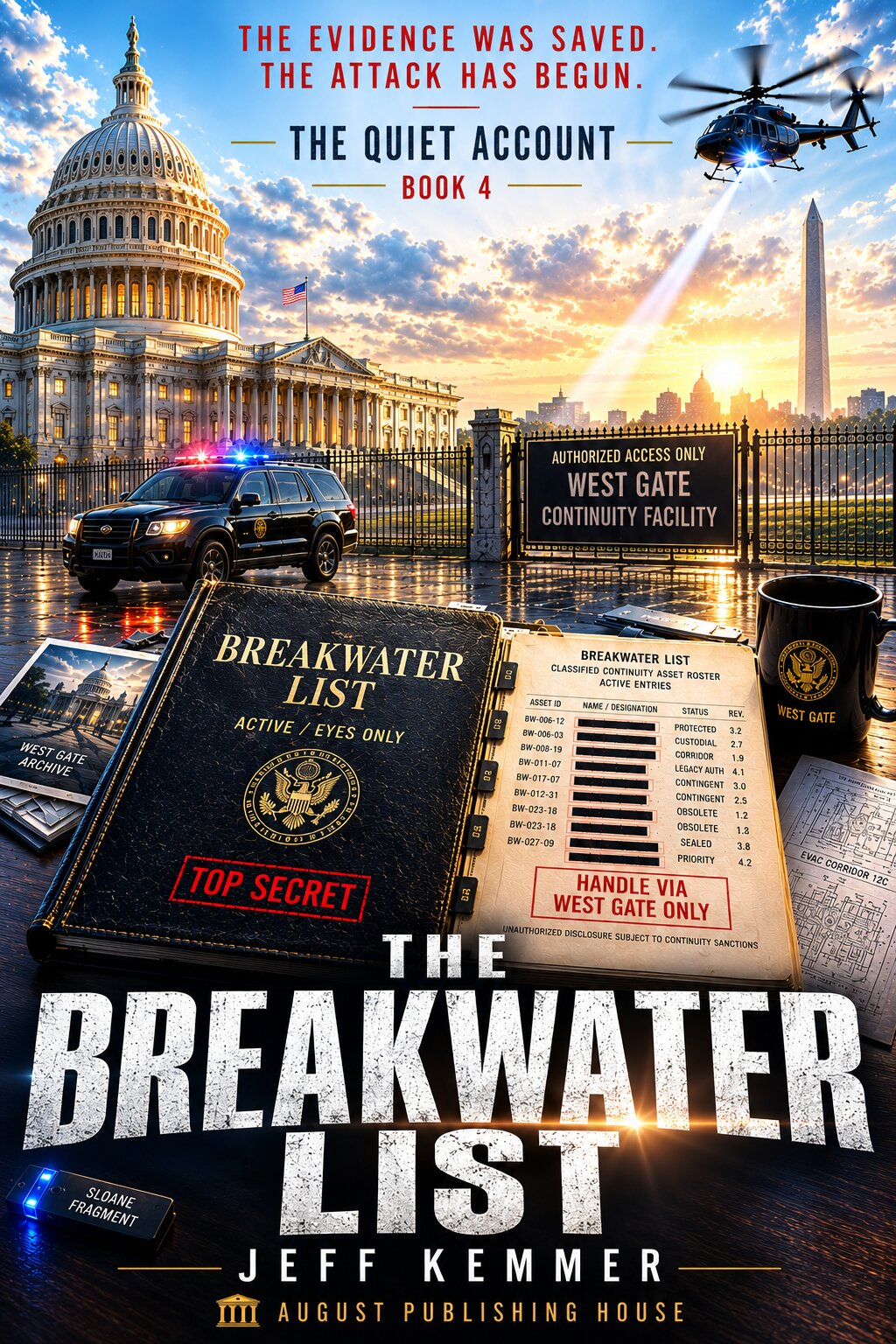
Book 4 opens in the immediate aftermath of PORTFALL: Rusk is alive in federal custody, Hollis is detained, Harborlight’s port corridor is preserved, and Hale’s narrow directive has stopped one seizure route while enraging Congress, contractor counsel, and executive hardliners. In Judge Kessler’s black-box room, PORTFALL remains archived, but the authenticated Sloane-class fragment has revealed BREAKWATER, a separate active list kept by Gordon Pike. Almost at once, Pike begins selectively surfacing names and West Gate references through channels only Hale, Sloane, and Audrey’s old architecture could recognize.
The first crisis is not another disaster alarm. It is an interpretation. BREAKWATER appears to name protected people, obsolete evacuation corridors, sealed authority triggers, contractor-linked custodians, and old Cascade-era exceptions. Some entries look like evidence of blackmail and human-handle routing. Others look like remnants of a real continuity shield that may still prevent civilian deaths if exposed too quickly. Congress, led by aggressive investigator Victor Rowe, demands sealed-list disclosure under the argument that Hale and Kessler are hiding an unlawful shadow government. Castellan’s senior defense, now represented in part through crisis executive Reed Calder, argues that the list proves Rusk and Hollis were operating under legacy authority rather than criminal conspiracy. Rusk exploits custody by implying he can identify final authority only if moved into a controlled national-security review channel. Marsh remains legally insulated, his signature evidence dangerous but not yet dispositive.
Daniel’s temptation sharpens because BREAKWATER sounds closer to Audrey’s final warning than PORTFALL did, yet Audrey’s ring remains in court custody and the system does not request it. Beth and Kessler must rebuild access rules after Avery’s exposure, while Tully’s vice-presidential office becomes a constitutional weapon: every protective order around her is cast as proof that the judiciary has captured the executive branch. Hale must confront West Gate and the Cascade archive he has avoided, assisted by retired continuity counsel Claudia Ames, who helped draft exception language that may explain how a shield became a list other men could own.
Rachel Dunn and new Coast Guard legal liaison Nora Keane validate which BREAKWATER-linked claims involve genuine maritime or evacuation risk, while Allison, Maya, Sam, Mercer, and Nina build admissible proof around old ledgers, paper manifests, custody templates, and public-information sequences. Sloane continues sending useful fragments that cannot be trusted. The book’s pressure comes from a narrowing question: can the coalition define BREAKWATER in court before Pike forces Hale to acknowledge it, Congress tears it open blind, or Rusk turns it into his escape route?
Share